



For architecture and engineering firms, the firm profitability is a result of many factors. Many firms struggle to know what contributed to their success or failure to achieve profit goals.
The threads of team capacity, project schedules, and client budgets weave together to form this story. But understanding this story requires the right data, the right setup, and the right analysis.
In this two-part blog, we will cover the prerequisites to achieve firm profitability. Then we will follow up with ways to measure and respond to improve profitability.
As part one, this blog post looks into the essential data you need to view and record. Moreover, it discusses how those numbers should relate in order to find out if your firm is set up for success.
Building the Firm Profitability Foundation: Data as Your Compass
Before looking at project performance, you need to have certain numbers available to track overall profit, cost, and goals. These are crucial to establish a baseline. These are the key data points for the purpose of our discussion:
- Ensure the ability to track overall firm profitability - encompassing all income and expenses.
- Record your firm profitability goal so you can track your progress.
- Ensure visibility into your monthly firm cost, specifically focusing on team labor cost.
- Record your team capacity or the total number of hours that team members could work without incurring overtime.
- Record your team utilization targets or target billable percentages for each employee. It will likely be two different types. One team works on client projects and the other team performs back-office activities.
Measure Your Potential
Once you have the above data, it's time to assess your firm profitability potential. We’re going to determine a few key values:
1. Earning Potential
This is the expected revenue you will generate per month if each team member hits their utilization target. Calculate this by looking at the total capacity of each team member, then multiply those hours by the target utilization. This is how many hours the team member should bill to clients.
Multiply this number by their average billing rate. If they bill at the same rate on all projects, this is quite simple. But you may have projects where rates vary.
2. Profit Potential
This is the theoretical profit you could earn. That is assuming your cost remains consistent and you achieve the earning potential. Simply subtract your overall monthly firm cost, including overhead and operating expenses, from your earning potential.
Now, the crucial question:
Does your firm profitability potential align with your profit goal?
If your profit potential exceeds your profit goal. Then you’re at least set up for success and ready to track your cost and revenue. Do it as you actually do project work to see if you are on target (see the second part of this blog for details on how to do this!)
If your profit potential is less than your profit goal, it’s time to make some adjustments. This tells you that you’ll have to exceed your own utilization targets to hit your goal; the likelihood of doing so is quite low!
Set the Stage: Increase Potential to Hit Your Profit Goal
The calculation for potential is a simple one: target revenue minus overall cost. In order to increase the result and get it at or above your goal, you’ll need to either increase the target revenue or decrease overall cost.
Let's discuss ways to increase target revenue:
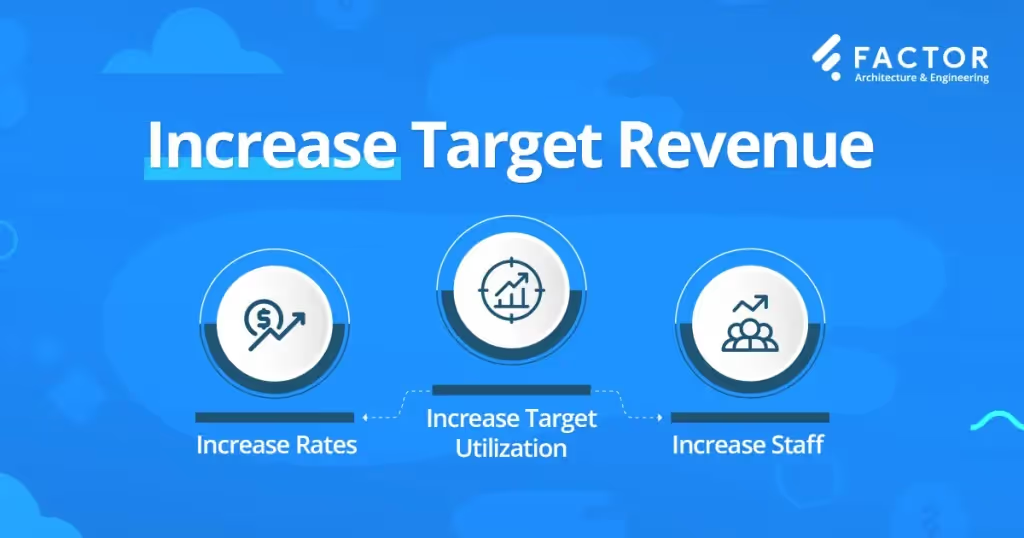
Increase target utilization
You could increase the number of hours team members are expected to work on billable projects. The limiting factor here is capacity and how your firm’s culture handles the reality of non-billable meetings and overhead in the work week.
Increase staff
You could increase the number of billable hours overall. This also increases cost, since you’ll have additional salary to cover. But assuming your billing rates cover salary and overhead cost, you should hit target revenue faster than overall cost to improve overall profit potential.
There is a limiting factor here. You need to have enough billable work in the pipeline so your staff is not on the bench earning salary without billing hours.
Increase rates
You could increase target revenue without adding staff, so long as the staff you have are hitting their utilization targets. The limiting factor here is obviously the tolerance of your clients for rate increases and how competitive your market is for rates.
The other way to improve profit potential would be to decrease costs:
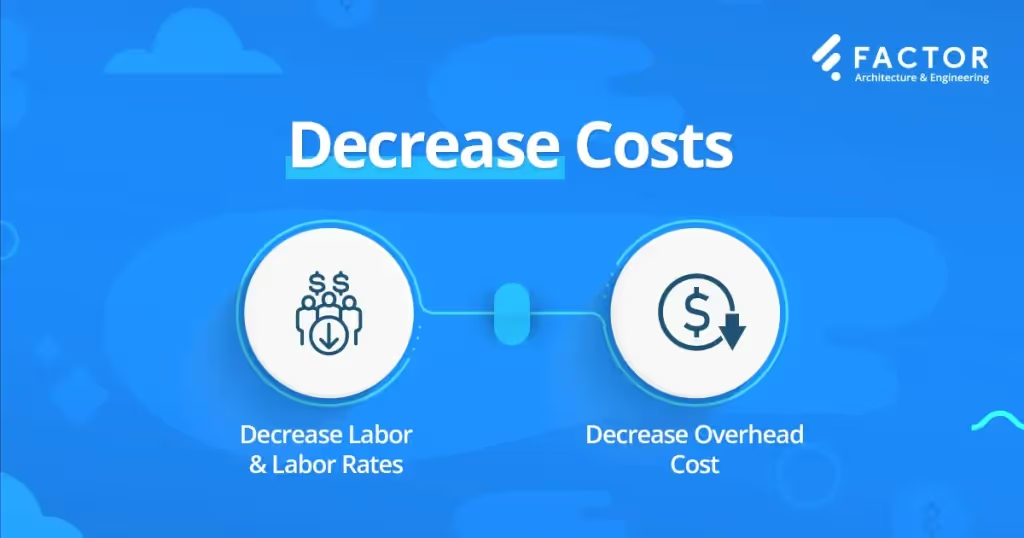
Decrease Labor & Labor Rates
This is a risky move. You either decrease staff or pay your employees less, which is risky in a competitive job market.
Decreasing staff also negatively impacts your target revenue at a greater pace than it decreases cost.
Decrease Overhead Cost
You do this by decreasing what you spend on non-billable staff (which can have the same negative consequences as above). You can also cut costs for other office expenses. This includes your lease/mortgage, training, benefits, or other operating costs.
As you can see, there are better options for increasing target revenue. You can balance utilization, rates, and staff with capacity, market, and sales.
Conclusion: Steer Towards Firm Profitability
To summarize: with the right data, you can quickly analyze whether your firm is set up to hit its profit goals. If you are not set up to beat your goal, consider ways to increase target revenue or decrease cost to improve that potential.
If your profit potential is currently at or exceeding your profit goal, you can move forward with a strong foundation. In part two of this blog, we’ll discuss how to measure the results of your work to the numbers discussed here. We will reveal the causes of the discrepancy and action to get you back on track.

Recommended articles


See Factor in action
In one quick call, we’ll show you a simpler way to run projects and get paid faster.
.png)
“I recommend Factor to other firms. The team is great, it’s easy to use, and it has streamlined my project management. It can do the same for yours.”
Adam Mayberry
Architect / Managing Principal